A Century in the Driver’s Seat
Blessin Cho – Director, Sales Analytics Consulting & Insights
1926 – 2026 · Kelley Blue Book’s 100th Anniversary
How the American auto market transformed — and why Kelley Blue Book was there for every turn.
The 1920s were a transformative decade for the American automobile. Car ownership doubled. Closed-body sedans replaced open-air carriages. Technological innovations like electric starters and improved braking systems became commonplace — and for the first time, owning a car stopped being a luxury and was accessible to the middle-class.
What other lessons did that era teach us? And how do they echo today?
The Market: Then (1926) and Now (2026)
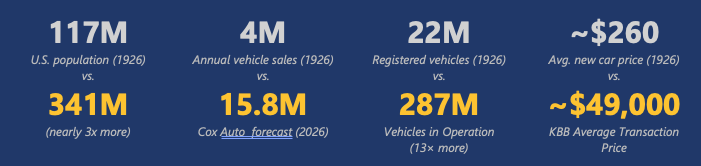
Data-Driven at the Core
Then: Making Cents with Sense
In 1926, The Blue Book was first published with appraisal values for vehicle acquisition. Data transparency was at the core of it then
Now: Same Question, Different Channels
The vehicles have changed. The sticker prices have certainly changed. But automobiles remain one of the most expensive purchases most people will ever make, and information remains the deciding factor in how confidently they make it.
Today’s buyers spend over 12 hours researching online before they visit a dealership. Over 80% of online car shoppers research prices before setting foot on a lot. Vehicle pricing data is more relevant than ever — giving transparency to dealers and buyers alike. A hundred years later, we’re still answering the same question: what is this car actually worth?
One in four new vehicle buyers used AI tools during their buying journey in 2025 — and that number is accelerating. As buyers turn to ChatGPT, Google Gemini, Perplexity, and others to answer questions like ‘what should I pay for this car,’ the answer they receive is only as credible as the data behind it. As we look ahead to the rest of 2026, visibility across all the major LLMs as a trusted, citable source of vehicle pricing and information is critical. Kelley Blue Book (KBB) is playing the same role it has played for 100 years, now in the channels where the next generation of buyers are starting their search.
Affordability
Then: The Price Drop That Changed Everything
In 1910, a Ford Model T cost more than $800, (roughly $27,000 in today’s money) too expensive for most working families at the time. Mass production changed that fast. By the mid-1920s, the same car cost $260, (about $4,800 today) still roughly 21–25 weeks of wages, but for the first time, within reach.
Now: Higher prices. More cross-shop
Today’s average new vehicle costs $49,191 (KBB, January 2026), and the Cox Automotive/Moody’s Analytics Vehicle Affordability Index puts the payoff time at 35.6 weeks of income — longer than a century ago. New-vs-used cross-shopping reached an all-time high at 43%, a signal that price pressure is driving buyers up and down and across the market.
Affordability shaped the car market in 1926, and it’s shaping it again now. When every dollar is being stretched, consumer advice, transparent pricing, and practical tools don’t just help consumers — they drive consideration. KBB’s role in that moment has never been more direct: intercepting buyers early, with independent data they can trust, before they’ve made up their minds.
The Car Becomes Personal — and Stays That Way
Then: More Than Just Better Horsepower (literally)
Before car ownership became widespread, American life was mostly localized-and those local areas were small. A horse-drawn trip. A streetcar line. The distance you could cover before you had to turn back. With widespread car ownership, it gave Americans the open road, and everything that comes with it: freedom and a sense of new possibility. Alfred Sloan’s vision at GM — “a car for every purse and purpose” — formalized this shift, aligning brands to different needs and lifestyles in a way that still shapes the industry today.
Now: A Dizzying Array of Choices
A car for every purpose has never been more true, or more complex. In 1926, the Model T alone represented roughly 40% of the market. Today, KBB tracks 48 brands and 481 distinct models-spanning subcompact to full-size, non-luxury to ultra-luxury, and every major powertrain from gas and hybrid to electric, plug-in hybrid, and fuel cell.
The range can feel overwhelming, and for most shoppers, it is. Only 37% begin their journey knowing exactly what they want. That uncertainty shows up clearly in how people shop. On KBB, Midsize SUV shoppers consider an average of seven other vehicles across three segments. Compact SUV shoppers evaluate nine vehicles across four segments.
In 2026, the challenge is helping shoppers navigate the many vehicle options available in the market. With 92% of buyers using content during their research, that’s exactly where KBB’s legacy of independent, data-informed advice matters most.
The trust Kelley Blue Book built over 100 years is the same trust buyers are looking for today — and it’s exactly what will carry our brand into the remainder of 2026, and the next century.
Thanks for coming on this ride with us. Here’s to another 100 years!
Sources: KBB Average Transaction Price Jan 2026 · Cox Automotive/Moody’s Analytics Vehicle Affordability Index Jan 2026 · Cox Automotive Car Buyer Journey Study 2025 · Cox Automotive Q1 2026 Industry Insights · FHWA Historical Data · Motor Magazine 1922 · BLS Historical Wage Series
